"There is an intellectual desire, an eros of the mind. Without it there would arise no questioning, no inquiry, no wonder." Bernard Lonergan

"It seems clear that humans cannot significantly reduce or mitigate the dangers inherent in their use of life by ccumulating more information or better theories or by achieving greater predictability or more caution in their scientific and industrial work. To treat life as less than a miracle is to give up on it." Wendell Berry

"Do not be afraid, my little flock, for it is the Father's good pleasure to give you the kingdom." Luke 12:32

Saturday, March 22, 2014

Jerusalem, Day 1 Part 1

I am going to write two different blogs today.  Because we had two different days, even though it was technically the same day.

This is part 1.

Let me say this:  there are lots of ways to come to Jerusalem, to the Holy Land, to Israel and Palestine.  Some come and see only biblical sites.  Some come and see biblical sites and new testament era sites.  Some come and see biblical sites, new testmanent era sites, and shrines.  And some come and see biblical sites, new testament era sites, shrines, and try to meet people living in the current reality of this place which is complicated at best.  

Our trip was designed in this final category.  The way Dan (the fellow who organized the trip) and I describe it as we want to see the ancient and biblical stones of this place, and we want to meet and hear from the living stones of this place too.

So the first part of the morning was spent on the Mount of Olives.  And the afternoon and evening were spent with two young women working for peace in this place who showed us many places and many things that made the conversations about walls and check points very, very real.  

So today was a day for making things real.  The valleys and hills of biblical Jerusalem -- they are real.  The 24 foot walls dividing villages -- they are real.

This first blog is about biblical Jerusalem and what we saw on our way around it. About the first day we had here.


This is the route that Jesus likely took down the Mount of Olives on Palm Sunday.  Our group is in the background on the road.  Behind me are the acres of graves, Jewish and Muslim, seeking to be near the temple mound and the now sealed "golden gate."  If I was a more apolocalyptic theologian or pastor, I would write a great deal about this.  But instead I'll talk about what was there today.  

Here on the slopes of the Mount of Olives - the ground is crazy steep.  Like Blowing Rock or Boone steep.  Down, down, down it goes until it ends at the Garden of Gethsemane at the base of the Kidron Valley.  There to my left is a somewhat sacred Jewish site.  Notice the fence and the wire to prevent vandalism.  Irony:  Jerusalem is called the "city of peace," and yet there is security everywhere.  Checkpoints.  Young men with guns.  Young soldiers with guns.  Cameras, cameras, everywhere.  That is one just over my left shoulder on a thin white pole.  Cameras dot the whole way down the Mount of Olives.  And I get that. 

I understand their necessity.  

They just break my heart.

To my right is a beggar.  He was loud and desperate.  You should know I rarerly, if ever, give money to beggars.  This is for many reasons -- and all of them intellectually interesting and acute.

If you read the gospels Jesus goes us to Jerusalem from Jericho.  In Jericho Jesus meets Zacchaeus and Bartimaeus.  Batimaeus is a blind man who gets louder and louder and louder.  Jesus stops.

So here we were on the Mt. of Olives, and a beggar shouted louder and louder as we appraoched him.    We are on the same route Jesus took.  We are on the same Mount of Olives where the road to Jercho in Jesus' time both began and ended.  The city was before me.  The words of Jesus to "do to the least" of these echoed in my ear.

So I broke all my neat intellectual rules and I gave the man all the money in my pocket.  Don't know how much (I think about 5 dollars).  And it really doesn't matter.  There were too many synergies to deny the man a brief success.  If even for a moment, I hope he saw in it the top-pence I offered him the  mercy I intended.

(There are 1.000.000 pictures of the Garden of Gethsemane on the internet.  This is my contribution to the library of the photographs.  It really is as cool and wonderful as I hoped it would be.  It looks like the kind of place where one could get lost in prayer.  Is there a more tragic and/or sacred place for the intesction of the human drama that at Gethsemane?)


At Gethsemane and the Church of All Nations, or the Church of the Rock of Agony, people stream in from all over the globe.  Africa.  Asia.  Europe.  And us.  It is wonderful.


Here is the inside of the church.  It is the most visually elegant of the churches we have visited.  As I listened to the catholic mass and prayed for my family in this space, I tried to imagine the many who have come before me praying and praying for those they love and for the world.  

Again, I find myself looking at these ancient stones.  From the walk down the Mount of Olives, to the survey of the great city, to the place of Jesus' final prayer and arrest.

I find myself staring at the ancient stones and wondering what they remember. 

Jesus weeping over Jerusalem?

His long walk from Gethsemane to the home of the high priests, to the Romans, to Herod.  Do they remember that?  What secrets do they hold in the unalterable past?

And then I hear the voice of a beggar growing louder.

I hear the song of what sounded like 1000 Nigerians singing as they march down the hill.

I see the Ethiopians dressed in costumes which make them look like kings as they march the way to Jersusalem proper.

I see all that and I realize that these dormant stones yet support a living faith.

And I am glad for our part in it.

Friends, the city, at a distance really is as wonderful as you have imagined.  Its scope and place in world history is simply unmatched.

But the Nigerians singing, the people crowding, and the small group of North Carolinians who gathered together tightly to pray the Lord's Prayer this morning?  

Well, they are beautiful too.  And for each of these, I am, as I am for this city, prooundly grateful.


Friday, March 21, 2014

Lessons from Mar Elias

I looked at him and I said, "Thank you for your work.  My wife is a 7th grade teacher, her mother was a teacher, so was her father.  And my mother," I told him, "has been an educator for 45 years.  We are a family full of teachers."

"Your work has touched my heart."

Perhaps it is that I have been away from my family for a while.  Perhaps it is that school is an every day, sometimes hour to hour, conversation at my house.  Maybe it is because I love teachers because the people I love most are teachers.  Maybe it is because I believe - personally and theologically - that education is the most important community undertaking and responsibility.  But when I said the above words to the Headmaster of Mar Elias School, a school in Ibillin, in Northern Galilee, I said them from the heart and I'll confess to choking back a tear.

(Most students have Fridays off here.  This is one of the few places anywhere in this country where Muslims, Jews, and Christians study and go to school together.  Here are the students who came in today to be our lunch hosts - these youth are all 9th and 10th graders.)

(Earlier in the day 11th and 12th graders gave members of our group a tour of the school.)

(We made a donation on the part of our group to the library.  Mostly fiction books requested for the older students taking English classes, but also hard to import books on teaching excellence and teaching theory.)

(Other members of our group visited a regional program for gifted students hosted at the schools.  These students are among the top 1.5% in their grades, and they come from all over the region on Fridays - 30 Fridays a year - for an extra day of school to be in class with other exceptional students.  These 6th and 7th grade girls are taking a class which encourages them to think about cities of the future.  What architectural, environmental, and artistic needs will they have?)

(These 8th graders - also part of the 1.5% program - are in debate class.  As we entered they were practicing point and counter-point about raising the legal age of marriage.  They wanted to know the legal age of marriage in the United States.)

(The high school building.)

(The Melkite Catholic Church at the center of the school.  The Beatitudes -- see Matthew 5 -- are inscribed in four languages going up the steps.  The school is currently 60% Muslim, 40% Christian, and welcomes many Jewish teachers.  The faith of this church community drives all they do.  From the Beatitudes, the words of Jesus which call for peacemaking.  To the call of Jesus to welcome children in his name.  This is the driving faith of this school).

(Members of the group prepare to hear the school's founder, Archbishop Elias Chacour speak.  We were joined by a group of students from Notre Dame as well as Kate Tabor, PCUSA's new facilitator for peace making partnerships in Israel/Palestine.)

(Archbishop Chacour address our group.)

Here is where the blog will get thin.  For two hours Elias Chacour told us stories, called us to action, told us that peacemaking was the primary call for Christians (as in others will know who God and Jesus are by the peace we make in the world), talked about the children of the school he founded, and told of his friendships with incredible people all over the world.  It was spellbinding.

And not just because of the qualities of the stories.

Because of the qualities of the man.  The faith of the man.  The courage of the man.  The way his devotion to Jesus and to the beatitudes have guided his witness in this small town of Ibillin and then, across the planet earth.  If you have never read his book, Blood Brothers, I hope you will read it.  And soon.  It is an important a book as I have read in many years.

He said so many things.

He speaks with courage and conviction about the violence that has hurt his land.  He calls all to remember that Jewish folks are created in God's image.  He calls all to remember that Palestinian folks are created in God's image.  He calls all to remember that there is ministry to do, there is faith for Christ and the love of Christ to share, where ever anyone of us may be ("I came to Ibillin for a one month assignment, but my bishop forgot me, and I forgot myself, and I have been here for almost 40 years").

And then he said this, "Please tell your friends in America that the Palestinians and Jews don't need to learn how to live together in peace...tell them that we just need to remember how we did it long ago."

I pass that on to any who read it, as I was asked to do.

There are people who talk about what they should do to make peace, help a need, love a neighbor as themselves and make their actions a witness for Christ.  No matter where we are there is a need for our faith and for our helping hands in our zip codes, county, or country.

And then there are those who do what is needed.  Who break ground.  Till soil.  Raise a helping hand.

Archbishop Chacour is a doer.  Devoted to God, lover of Christ, he has devoted his time and attentions to doing precisely what Jesus said.

When such a great example of service to God and the kingdom of God -- when something like this occurs in your midst, it is good to take notice.

I noticed today.

And it brought tears to my eyes.  It reminds me of the idealism with which I began seminary.  And it made me proud of our shared faith.   It made me humble before the  Lord, the  Lord Archbishop Chacour has so devotedly served.

(I write these words tonight from the Old City in Jerusalem.  The calls to prayer have just begun.  They echo through the city and its tight streets.  Darkness has fallen.  Tomorrow will come, and with it, Lord willing, the dawn.  And with the dawn explorations into the complexities of this city and explorations into the trial, death, and resurrection of Christ.)

We have come up to Jerusalem.  This trip - from Jordan, through the Negev, to Galilee, now to here, have given us much to think and pray about.

"Jerusalem - city of so much pain and joy.  The drama of crucifixion.  The wonder of resurrection.  Help us O God to see our faith clearly through what has happened here.  And then help us O God to see Jerusalem today - that we might know how to pray for peace in this complicated land.  Carry us forth to discover your good news, for these things we pray in your name, Father, Son, and Holy Spirit.  Amen."


Thursday, March 20, 2014

Zippori? Nazareth?


(This is Zippori.  Actually, me in Zippori.  I'll write more on Zippori later in this blog.  I am never sure how many picutres of myself to include in these posts...) 

Today we went to Zippori.  Dan (the other organizer of this trip and honestly the person who has done the vast majority of the work for it) and I really wanted to come here.  In the picture above I am in Zippori, now an Israeli National Park.  Zippori was the "capital of Galilee," next to the major Roman highway the Via Maris.  And it is only 2 or so miles from Nazareth.  At the time of Jesus' boyhood, Nazareth would have been a village of 200 or so people, most of whom lived in caves.


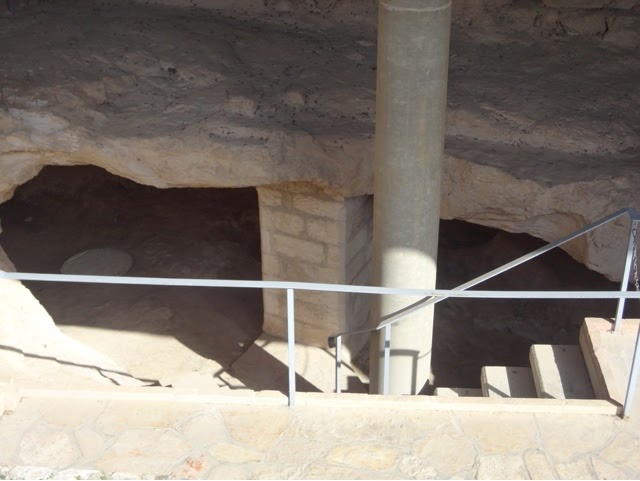
Caves like this one, preseved by the Roman Catholic Basilica of the Annunciation in Nazareth.

Zippori was cosmopolitan, Roman, and a major center for Jewish learning.  Along the Via Maris, it is a place where Jesus would have been exposed to the cutting edge Jewish thought of his day and to hours on end of Old Testament commentary and discussion.  It was also, as a Roman city where Herod built a palace/fortress a place where Jesus would have seen many, many gentiles.  Thus, many scholars think most of Jesus' formal education took place in Zippori.  It is impossible to know.  What we do know is that when he arrived in Capernaum after that long period in his life between his visit to Jerusalem at 12 and the time when he called his disciples, he became wise and learned and grew in his understanding (see Luke 2:52).

So Zippori is an important, and often overlooked stop when visiting the Holy Land.

(Zippori was a Roman city, and reached its apex in the 2nd century.  The Israeli's call it the jewel of Galilee, in part because after the destruction of the temple in 70 AD, the Jewish leaders resettled there in Zippori.  This means that Zippori was integral to the formation of the Talmud and the Mishnah, critical texts for Judaism even until today.  Above are chariot tracks -- this is for my kids:  P, G, and A these are real chariot tracks on the Cordo Maximo in Zippori! -- which is evidence of its value as a commercial center.)

As we pulled into Nazareth, one of our group members (I'll call him "J") started singing The Band's song, "The Weight."  You may know it:  "I pulled into Nazareth, I was feeling about half past dead."

Nazareth in the days of Jesus was a little village.  Today it has 100,000 or so people.  It is bustling and crowded.  Cars going every which way.  Vendors selling everything under the sun.  Noisy, smelly, and, especially when counting the pilgrims here, international.  At our hotel, which seems to be owned and managed by Palestinian Christians, we have met Palestinians who were born in Georgia, who live here but travel to Europe monthly, or who have family currently in the U.S..  Nazareth (google this phrase, "what good can come from Nazareth?") is not overlooked town anymore.

(Members of our group on the bus headed to Nazareth today.)

(The streets of the old city are crammed and covered.  Here is our guide, Tony, with members of the group milling around and shopping in the crammed streets.)

(Here we are walking to our hotel in Nazareth.  The streets are so tight the bus has to drop us off and we walked the rest of the way.)

Nazareth has Christians, Jews, and Muslims -- native Palestinians and people who have moved here from around the world.  There is graffiti.  There is Western Music -- I heard "Thrit Shop" by Maclemore booming from the health club and the aerobics class on one side of the hotel.  On the other side middle-school boys with Premire League team shirts played soccer on the playground at the Greek Orthodox Church and school (P,G, and A - I have a video!).

Nazareth also has pilgrims.  The Basilica of the Annunciation is the largest church in the Middle East.  Its scale is unmatched by any church we have seen.  Nothing is even close.

The annunciation is, of course, the announcement from Gabriel to Mary, in Nazareth, that her child would be Jesus.  And that is kind of a big deal.  And people - Catholics, Pentecostals, Europeans, Africans, Arabs, people speaking Chinese, and at least 19 North Carolinians -- people stream from all over the world to pray here and gaze upon the church.  Here is what you need to know:  the church is built over 2 or 3 other churches which had occupied the site before.  And on the bottom floor of the church is the cave where many believe that Gabriel spoke to Mary (though this is contested).  The architecture is stunning.  My pictures do not do it justice.

I will share this:


And this:

This the front of the church.  Carved into the limestone are the Latin words, "Verbus caro factus est et habitavit in nobis."  From the Gospel of John - "And the Word became flesh and lived among us."

Incarnation. It doesn't start in Bethlehem.  It starts in Nazareth.  That is why Mary is so venerated and why the church is so important here.

There are people who have a mystical experience when they come here.  I get that.

As we sat in the Basilica, an English speaking priest read the anunciation story from Luke in English to the people he had brought here.  To hear that story, Gabriel saying to Mary, "greetings favored one!" in this church over that cave!  A moment!  And I get that.

But beyond the mystical is this.  Jesus was not invented.  He was real.  Flesh and bone like you.  Like me.  He had a history and place.  And it is all around.  And no the history since then is not clean or easy or simple.  Yes it is contested and debated.  There are points, counterpoints, and everything in between.  To many of my friends the church must seem more like crossfire than peacemaking.  

Even in light of all of that, it is a claim we can make becaue the Savior was real and he was here.  Blocks from where I sit.  At some point in time, he walked this hill as we do today.

And the real-ness of that claim cannot be undone.  Even the simplest person has a real history and a real claim.

And this claim about Jesus?  Well, as I said yesterday, it is available for any.  And if we listen to what he said, and give witness to who he was?  My goodness...

My goodness...

My goodness.  That is grace abundant.

"And now our God, grant us peace for the night. That here in Nazareth we might see something of the story of our Savior that we have never seen before.  And seeing it, we might ever seek to share, that others might hear of your love, your peace, your grace, your forgiveness.....  Amen."


Wednesday, March 19, 2014

Tu Has Venido A La Orilla


"Peter do you love me?"
"Yes Lord, you know that I love you."
"Feed my sheep."
John 21

History, fact, tradition, legend.  Bible, narrative, folklore.  It all has a way of blending here.  The biblical narrative oozes from the hills.  Places commemorate key moments of the life and ministry of Jesus, and though we have no way of knowing exactly where any of the stories, healings, and teachings happened, the point is they happened very, very close to here.  Along that very lakeshore you see above.  From the shore of the Sea of Galilee, up to those hills which surround all sides of this north and northwest corner of the lake, yes right here, most of the early ministry of Jesus took place. And every few hundred yards there is a church, a site, a marker, a view, something which celebrates the ministry of Jesus.  To read all about this area, read Mark 2 - 5, or Matthew 5 - 9.  All of the miracles of Capernaum, the sermon on the mount, the first sermons of Jesus, the walking on the water, the calming of the storm.  All here.  Right here.  And though we cannot prove that Jesus preached the sermon on the mount at the mount of beatitudes -- to read the beatitudes on or near the very collection of hills where Jesus gave them to us?  Among the more powerful experiences I have ever had with scripture.  To remember the loaves and fishes near the site where it is believed to have happened?  The same.  To see the archaelologically reputed home of Peter, the foundation of the synagogue where Jesus would have preached and taught in Capernaum, the area of the town where he might have found Levi and called him?  More of the same.

(Blessed are the peacemakers for they shall be called children of God - from the little Catholic Church which commemorates the preaching of the beatitudes.)

(The reconstructed 4th century Synagogue at Capernaum.  The foundation of the 1st century synagogue's foundation is just to my left.  This 1st century synagogue would have been the location of all of Jesus's preaching and miracles in Capernaum - Mark 2 through 5.)

(An icon in the church of the multiplication, near the miracles of the loaves and fishes.)

I cannot tell you how special today was to this student of the New Testament.  It was a day spent in scipture and for this I am grateful.

One thing to note, which I never realized until I came here to see it.  Everything is so close.  All the "he went to the lakeside, he went across the lake, he went to the mountain, he went to Capernaum, he went to the land of the Gerasenes" -- all those verses -- it is all so close together.  Seeing all these places has opened up the scriptures to me and I am beginning to understand the movements of Jesus in whole new ways.

One other thing:  as I expected, this place is covered with pilgrim-like tourists.  Just like us.  One can hear every language and any language at almost any given moment.  We all crowd in and push to see.  At one level it can be hard to hear the guide over all the other guides.  But on another level that is as it should be.  The good news of Jesus is not exclusive to anybody's tongue or anybody's church.  It belongs to us all.  Grace is available and sufficient to anyone who might follow.  It is not birthright or brainwashing. It is baptism and welcome.  It is Christ saying, "Follow me," and then following.  And many do follow.

(Our group gets "lost" and pulled toward the "home of Peter" with folks from all over the world.  That church is the Franciscan church built over the site.  From inside the church one can look down into the home of Peter - the sight which letters corroborate from the 4th and 5th centuries was Peter's house.  This would have been "home" for Jesus whenever he stayed in Capernaum.  It is a very busy place, a huge archaeological site, and one of the best things we have seen since we arrived.)

(Our group is on the the left.  Look at the others around.  Groups, individuals.  All trying to glimpse the places and spaces where Jesus likely walked and taught.)

(A panoramic shot of the Franscican church over the St. Peter's site.  The columns commemorate the miracles at Capernaum - which you may read about in Mark 2 -5.)

(Our group rides on a boat on the Sea of Galilee.  This was as relaxing as it looks.  Really allowing for a better understanding of the economy and the lake-like living of Jesus's time and his place.  Boats hustling across the lake all day.  Those same boats fishing at night.)

(By the Sea of Galilee near the spot of the breakfast and the command to "feed the sheep and tend the lambs" given by Jesus.  Read John 21 to seee the whole picture.  That sign to my left says no swimming and no cooking.  If you read the text you might understand why.)

(Our group under a shady tree near the monument to St. Peter.)

For a long time my favorite hymn has been "You have come to the lakeshore," or "Tu has venido a orilla."  It is so wonderful.  Seeing the lake, seeing the hills, I can't sing that hymn the same way again.  Seeing the world changes everything the anthropologist have taught me.  I agreed.  It's different in a good way.

There are days when one is humbled by the privilege of the call to ministry.  Humbled by the privilege to study and read and teach and preach.  Today was one of those days.

I found myself humming quietly as our bus descended the hills, back toward the sea, back toward the lakeside these words from the hymn:

"Lord, you have come to the lakeshore,
looking neither for wise nor for wealthy.
You only wanted that I should follow.
O Lord, with your eyes you have searched me,
And while smiling have called out my name.
Now my boat's left on the shoreline behind me.
And with you I will fish other seas."

Friends, the loaves and fishes can be multiplied!

The peacemakers really are blessed!

The call truly is to feed the lambs and tend the flock!

What a beautiful reminder today of all the God has asked to do.  Thanks be to God for the call, and for the One who first followed, and then called us from the lakeshores.  Thanks be that the Savior then bids us to seek, serve, and love our neighbors near and far.


Tuesday, March 18, 2014

See

(One of the inscirptions from the documents found with the community rules of the Essenes.  This is from the National Park at Qumram, the location of origin of the Dead Sea Scrolls).

Today was an emotional and spiritual whirlwind for me.  It all happened so fast.  I must have taken 10 pages of notes, 80 pictures, and had 1,000 thoughts.  My guess is that you could ask every member of our group and they would say the same thing.

In order, we visited Massada, Qumram, Jericho, the Mountain of Temptation, and the Jordan River.  I write at this hour only a stones throw from the historical location of Magdala (think Mary Magdalene) as I overlook the Sea of Galilee or the Sea of Tiberias (and it is known by two other names as well).  The moon is full and its reflection on the water brings a peace to the mind.

The challenge tonight is to keep it brief.  I think I have failed.

(Tony, our guide for this part of the journey, shows us the Roman bath house at Massada.  The black line on the wall represents what was found by the archaeologists when they began excavating and restoring in the 1950's.  Everything below the line is "original."  It is worth nothing the terra cotta on the left - it is the way that the Romans heated the air and the walls to make the sauna hot.)

Massada was a truly fantastic experience.  It brought back so many memories.  The first time I read Josephus Flavius.  The first time my mother told me the story of Massada.  It brought forward so many feelings about the deep meaning of Massada and its psychological role in the complexity of the Middle East.  Even during our visit the site was overrunn by hundreds of young Israeli soldiers who still hike to the top to remember the Jewish resistance to the Romans.  Our group heard our guide recite parts of Psalm 121 in a small church that once had stood upon the site - for about 300 years from the 300's - the 600's AD.  Hearing about God's goodness in the hills while standing upon the hill that was and is Massada?  The first of many unforgettable moments from today.

(This picture is - admittedly - here for my children to see.  These are believed to be actual boulders hewn by Romans which they catapulted in their nine month assault on Massada.  If you have no interest in seiges, catapults, or 1st century battlements, simple skip this and move on.  P, G, and A - what do you think?  Actual projectiles!)

(Yes, that is Gloria Johnson who is on sabbatical right now, and happens to be travelling in Israel with a Columbia Seminary group.  The odds on us seeing her were very small.  But there she was, entering Massada as we were leaving.  How about that?)

Then we visited Qumran and like Massada, there is also something singular about Qumran.  If you google it you can see all you want to know about Qumran and why the Dead Sea Scrolls ushered in whole new eras of Biblical scholarship as well as new understandings of the Essenes.  Beginning in 1952, and continuing until today, it also revolutionized biblical archaeology and helped to rewrite the history of this area.

(One of the many caves of Qumran.  It is in a cave like this, where the Dead Sea Scrolls were hidden for 1900 years).

More than anything else, both sights, Qumran and Massada bring into full light the age old conflict between idealism and realism.  Both the Zealots who lost their lives at Massada to the Romans, and the Essenes who hid their great works from the Romans as they fled their homes, were idealists in the strictest sense of the word.  Neither group would survive the Roman suppression of the Jewish revolt in Palestine during the late first century.  As far as 1st century world events go, none casts the shadow this suppression does.   As part of this suppression, in 70 AD the Romans destroyed the Temple in Jerusalem.  A Temple many of the Jewish people lament to this very hour.  The realists?  While the Romans certainly altered their lives and caused great suffering, many of them managed to survive and many of their descendents surely are among those who populate this land today.

North from Qumran we ate lunch in Jericho.  Yes, that Jericho.  Zaccheus.  Bartimaeus.  Jesus on the way to Jerusalem.  The Israelites and Rahab and the walls tumbling down.  Elisha and salt in the well.

(That giant mound is Tel-Jericho.  Somewhere in all of that is the archaeological evidence of ancient Jericho.  Whatever remnants of the walls there may be are likely to be in that pile).

Jericho is among the handful of cities which claim to be the oldest in the world.  It is the lowest city in the world.  Like the Dead Sea, it is hundreds and hundres of feet below sea level.  It is towered over by the Mountain of Temptation.  Where Jesus (according to legend) went for the 40 days in the wilderness after his baptism.

(Icons in the monastery on the Mountain of the Temptation.  The entire monastery is built around the rock where, according to tradition, Jesus was tempted for 40 days.)

The Orthodox Church has a monastery high upon the montain and the mysticism and sacredness of the place certainly felt foreign to this rational man of faith.  But I also can sense "holy" and know it when I feel it.  As I recited the story of the temptation to myself, and as I prayed the Lord's prayer ("lead us not into temptation") in that place, two men from Russia came into the room and completely prostrated themselves in the space beofre the rock.  They poured their whole selves into the prayers they prayed.  Each word was critical and important.  Their tears were real.  As I prayed my prayer near them I could not help but wonder if we in the rational West have lost something along the way?  No, we are not likely to be snookered by a religious charlatan, but sometimes in our "head first" dedication to our methods I think we miss the mystical.  And sometimes when we miss the mystical we dismiss the holy.  I was reminded once again (perhaps by the Spirit?) of the danger in neglecting the holy when it is in our midst.

About the distance from White Memorial to the N C State Veternary School is about how far it is from Jericho to the banks of the Jordan where "our" best guess suggests Jesus was baptized by John the Baptist.

(Members of our group visit the Jordan River on the westside, the Israeli side, of the river.  While difficult to describe, I will try to explain what you are seeing in this photo.  The water is high and full of sediment as it rained very hard earlier in the week.  Many scholars think that Jesus actually entered the water from the  east side, the Jordanian side of the river, directly across from us.  The church in the background is the Roman Catholic Church constructed on the sight in 2000 or so.  There is also a Lutheran Church and an Orthodox Church, all on the Jordanian side.  Behind us is a large pavillion that is wide open.  All around us were people reading and studying scripture - Christians and Jews.  People going well into the water, praying, singing.  The group across from us had drawn water from the river, and using the huge font in the center of the screen, were baptizing people there.)

I don't think I can really articulate what it meant to me to be there.  I gathered our group closely and we shared the story of Jesus' baptism.  I encouraged them to touch the water, remember their baptisms, to pray or recite whatever they desired to pray or recite.  Each person embraced the experience in a very personal way, and that felt right.  After I shared the story of Jesus and his Baptism, which was somewhere in the general vicinity of this spot some 2000 years ago, I touched the water with my left hand, and then my right hand, and I thanked God for my baptism and for the gift of forgiving and saving grace.  I then asked The Lord to bless my family and our church and I once again recited The Lord's Prayer.  I didn't take any water.  Instead I left my prayers with the water.  That felt right.


My overall feeling there was joy.  Being there made my incredibly joyful.  I pray I will be slower to anger, and more able to give myself to joy when it arrives.  I was able to do so today, and for this I am grateful.

For as long as I have read scripture, I have always felt drawn to Luke's gospel.  In Luke 18 and 19 we get the back to back stories of Bartimaeus and Zacchaeus.  Bartimaeus is blind, poor, a beggar.  Zacchaeus is rich, rich, rich - a tax collector.  They both need to see.  Bartimaeus because of his blindness and Zacchaeus because of his short stature.  They both need to see the new thing God is doing, to behold God's goodness in the world around them.  Both in Jericho, though different, they have a similar need.  And it is in Jericho they both gained their sight and saw clearly.

What did they see?

I cannot know.  But I trust that it was grace.  Grace abundant at that.  Grace in a loving God and loving Savior who would touch them and direct them to the fruits of the Spirit.  

I think that is why people come here.  I saw people catching a glimpse of that today.  Praying in a shrine.  Stepping into a river.  Looking into the water.  Standing near the story of our faith in order that they might see more clearly.

"God of all sight - that of the eyes and that of the soul - fill us anew with wonder ever day.  That in the Jordan or in our homes, we might see, see, see.  See clearly the wonder of your love, the beauty of your Spirit, and the mercy of your Son.  Amen."


Monday, March 17, 2014

Down, down, down...


Bet you didn't know that White Memorial was a seminary academy, did you?  Neither did we until we got to Israel.  Our group really liked this sign unti I declared that there would be a test at the end of the week.  

All kidding asdide, we were greeted by this sign in the window of our bus in Israel where Tony and Majdid picked us up.

Tonight we sleep at the Ein-Gedi Kibbutz Hotel.  We are at the lowest point on the earth's surface, along the banks of the Dead Sea, in the heart of the Rift Valley.  We are 1200 feet below sea level.  Surrounded by desert the Kibbutz is a shear act of will and land management.  It looks like a Spring blooming in the desert because it is.


Animals roam freely.  Plants from all over the world grow in every imaginable manner.  It is incredible.  Especially considering everything around it is a moonscape.  Desert.  In every direction.

(Hotels and resorts dot the shore of the Dead Sea.  These are half way between our overnight accomodations and the city of Eliat, where we entered Israel).

There is so little alive around here (including the sea), that the life-spring of the Kibbutz is enchanting; I find myself drawn into it.  My heart seemed to beat a little lighter as our driver turned into it, taking us from the desert and into something green, cool, life-supporting.  More on this later.

Most of the day was spent simply moving around from place to place.  We can say now that we walked into Israel.  Literally.  The bus dropped us off in Jordan.  We walked 100 or so yards through a severely fenced area, and, after more than 90 minutes in security and passport control for the 19 people in our group (there were only 4 others in line with us when we first arrived) we were able to enter Israel.  I have no pictures of this as cameras and security officers did not seem to be all that compatible.  It was a simple, but painstaking experience.  A good reminder of the complexity of this part of the world.  I can only say that from the travelers perspective the people in Jordan could not have been more pleasant or kind.  And, the Israeli's we have met so far are just as welcoming.  Kindness on both sides of the border.  Go figure.  And the painstaking security, most bags handchecked, every passport scrutinized, questions asked of each of us is a good reminder of the complexity of situation on both sides of the border.  And let's face it -- within a matter of miles of the Israeli city of Eliat, the nations of Egypt, Saudi Arabia, Jordan, and Israel all converge upon the Red Sea.  And that makes it complicated.  The kind of complication one cannot just wish away.

(Members of the group say goodbye to Jordan, and the east side of the Jordan River -- often overlooked parts of the Holy Land).

On the lighter side, we did get to "swim" in the Dead Sea.  It was the strangest sensation I think I have ever had.  The bottom is pure salt:  as if salt had turned to smoothish rock.  And the water simply will not allow a person to sink.  

Tomorrow we head out to Massada, before heading on Northa to Jericho and then Galilee (that is a slight schedule adjustment -security took 1 hour longer than expected).  

It is truly a full blessing in every sense to be here.  One experience builds into the next.  One thought leads to many, many more.  One insight to more insights... Were Sodom and Gomorrah near Mt. Lot, on the southern end of the Dead Sea?  How much did Jesus know of the tensions surrounding Massada - would he know what would happen there and how it would come to be a psychological and national symbol for the Hebrew people?  What will we feel as we journey to Galilee to the Mount of Beatitudes?  How close were we today to the spot where the Israelites walked over and through the Red Sea?


All around us the Biblical story unfolds and the metaphors of the Bible  - water, life, well, strength, sheep, shepherd -- they come to life.  One cannot help but wonder how green plants and life will return tomorrow when we start north and get beyond the Dead Sea and nearer the Jordan River.  It is little wonder that John and Jesus shared Baptism there, really.  From where they were there was desert all around, the Salt Sea (Dead Sea) to the South -- reminders of the fragile nature of life.  And in the place of convergence -- where outflows from two mountain ranges converge in the Jordan River -- where all the water and life gathers to sings songs of praise to God, that is where Jesus began his ministry.


Here at Eid-Gedi, we are closer that we have yet been.  I'll confess -- for my own part, I am excited about that.

"God - grant to us now the wonder of new eyes.  For faith.  For perspective.  For deep seeded feeling. Help us to see that, though far removed, the stories of your gospel migh preserve us yet.  Here in the land of your covenants and your promise, help us to know our own past more clearly, that we might, through your light see clearly into a future through which we might serve you with greater clarity:  loving you and our neighbors as ourselves.  In the name of the Father, the Son, and the Holy Spirit we pray these things.  Amen."

Sunday, March 16, 2014

Petra


I remember back at Seminary when a group of my friends went to the Middle East and to the Holy Land.  To be sure they talked about following in Jesus' footsteps.  But they also all talked about Petra.   

I have now spent an entire day in Petra.  I think I walked its grounds, surveyed its crags, up and down slopes in and out of caves for nearly 9 hours.  In all I think I walked 10 or more miles.

And like near everyone before me, I am speechless.


There is more to write than I can write.  More to say than I can say.  There is a reason that the world is trying to preserve it -- there are Unesco and USAid stickers in lots of places. It is, by my reckoning, singular.

Constructed in the hills of southern Jordan, bordering Israel, the Nabateans (who spoke Aramaic) and who were near the height of their power at the time of Jesus dominated the lands west of the Jordan River for hundreds of years.  They were master builders -- particularly of aqueducts and cisterns.  They were master traders.  Dominating the trades roots across Arabia -- connecting Africa, Europe, and the Far East.  So powerful were they, that they resisted the Romans until 106 A.D..  Which for a near-Meditteranean people, is a long time.  

The city would be polytheistic, then Roman worshipping, Christian, and Muslim before it was abandoned and turned over to Bedouins.  Lost to the West for hundreds of years, it was rediscovered as a lost city in 1812 by a Swiss explorer.

I think it is an important part of our trip for many reasons.  Primarily because it is amazing and it is singular in the world.  But also, and even more, it gives an idea of the complexity of the world in which Jesus was born, in which he taught, and then died and rose.  Look at the picture above.  It is the most famous Nabatean monument and it is a tomb for a 1st Century (BC) King.  Constructed just before the time of Jesus, it is a piece of multicultural and multi-national genius.    The figures?  Nabatean.  The urn at the top?  Greek.  The columns and the triangles?  Roman.  They had traded all over the world, and multiple cultures were infulencing their thinking and styling.  These people who spoke Aramaic, the language Jesus would have spoken at home, were world travelers and wanted to be seen as cosmopolitan, current, and engaging.

Are we any different?

I don't think so.

It boggles the mind.

The world in which our Bible takes place was complex, diverse, and in flux.  We'll see even more evidence in Israel.  But for now in Petra (Greek name), Sela in the Bible (Isaiah 16 and 2 Kings 14), the land of the Edomites in the days of Moses and later, Jesus, we saw evidence a plenty.  It is a day I shall never forget and I thank God for allowing these eyes to behold the majesty of the mountains and a specific genius of people, like us, created in God's image.  Both forms of genius are in abundance at Petra.

(Our group with Naim.  Naim led us off on a side trail, which included some light caving.)

(You might see someone you know here as we enter the cave.  I am proud to report everyone got out just fine.  I suspect we were very different than the folk who lived here 2,000 years ago.  The insides were plain but amazing.  Imaging this -- all that you see in this blog was cut by hand.  I'll say it again, it was cut by hand.  And the walls inside? Smooth-ish and realtively straight.)

(This is called the monastery because it was a tomb so large that it was made by the Christians into a Byzatine church for 300 or so years.  Yes, it is that big.  And it is up about 1000 feet or more above the rest of Petra.  Climbing up here was like climbing the trails near Montreat.  Only in desert conditions.  Again, remember, all carved by hand.)

(A Panoramic of the "Grand Canyon" of Jordan.  Way out to the west and in the distance are Israel and the Red Sea.)

(One of my personal favorites.  This is the cistern and baptistry of the Christian church excavation at Petra - you'll note the modern covering left by US archaeologists.  There was a church here from the 300's to 600 AD.  This was at the end of the day, and seeing this site, looking at the mosaics which still remain, and getting to pray here and recite a favorite Psalm or two was my worship on this Lord's day.  A blessing of a different sort.  An unexpected treat for me, really.)